Back To Thought Leadership

ARINC 818 Protocol Testing: The Hidden Challenges of High-Speed Avionics Video
Published: 02/03/26
Published: 02/03/26
High-speed digital video has become foundational to modern avionics systems. From head-up displays and helmet-mounted displays to EO and IR sensors and mission processors, deterministic and low-latency video transport is no longer optional. This is precisely why ARINC 818 exists and why it’s notoriously difficult in real-world protocol testing environments.
ARINC 818 was created specifically to support uncompressed, high-bandwidth avionics video with predictable behavior. Unlike consumer or commercial video standards, it prioritizes determinism, strict timing control, and fixed latency. These characteristics are essential for flight-critical systems where timing errors can directly impact safety and mission effectiveness.
When brought into the lab, however, those same requirements expose limitations in traditional test approaches. Many general-purpose test instruments are optimized for flexibility and throughput rather than cycle-accurate timing behavior.
One of the most significant challenges with ARINC 818 is timing. Frame rates, line timing, container boundaries, and idle insertion must all conform precisely to the interface control document. Even small deviations can cause display processors or downstream mission systems to reject data.
Software-based tools and non-deterministic interfaces often struggle to maintain this level of precision. Jitter, buffering delays, and scheduling uncertainty make it difficult to faithfully emulate real avionics video sources or sinks.
Bandwidth further complicates ARINC 818 protocol testing. Modern implementations frequently operate at multi-gigabit data rates with large frame sizes and minimal margin for error. Preserving signal integrity while maintaining protocol compliance becomes increasingly difficult, especially as systems scale to multi-lane configurations.
To address these challenges, many teams turn to custom FPGA designs, fixed COTS video equipment, or profile-specific ARINC 818 video converters intended for a narrow set of configurations. Custom FPGA development introduces high engineering cost, long schedules, and ongoing maintenance risk. Fixed COTS solutions may work for a single configuration but often lack flexibility when ICDs change or deeper protocol visibility is required. While an ARINC 818 video converter can be useful for basic translation or system bring-up, it’s typically optimized for operational compatibility rather than the timing control and protocol visibility required for deeper validation.
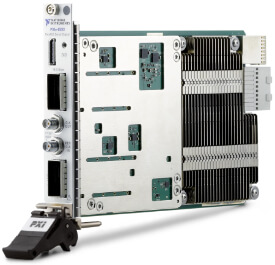
A platform-based approach that combines FPGA-based instrumentation with standards-aligned protocol implementation offers an alternative path. By moving timing-critical behavior into hardware and using modular test architectures, engineers can more closely replicate operational behavior in the lab.
PXI-based systems enable deterministic data movement, synchronized instrumentation, and scalable bandwidth, supporting more representative validation of ARINC 818 interfaces throughout the system lifecycle.
Learn more about NI’s high-speed serial and FPGA-based test platforms for avionics applications here.
If you need help finding the right interface, protocol or need to tweak our FPGA cards for your teams’ needs, contact New Wave Design to discuss your requirements.
Contact us today to see how New Wave Design can collaborate with you to achieve your objectives, leveraging our cutting-edge military and aerospace solutions. Experience our dedication to innovation, quality, and unparalleled customer satisfaction firsthand, and together, let’s turn your challenges into triumphs.
"*" indicates required fields