Back To Thought Leadership

How True SoCs Expand FPGA Capabilities for A&D Systems
Published: 01/13/26
Published: 01/13/26
FPGA engineering for defense and aerospace has reached a point where incremental gains are no longer enough to justify system complexity. Engineers are no longer deciding whether FPGAs can meet system demands, but how to architect them for heterogeneous computing at scale. That shift is accelerating the move toward true system on a chip (SoC) designs.
Field-programmable gate array (FPGA) technology is rapidly evolving to meet modern and next generation demands, and one of the most significant innovations is the move toward true (SoC) architecture. Here’s how SoCs enable heterogenous computing and expand next-generation FPGA capabilities for aerospace and defense systems.
In the past, a 3U VPX system might include a discrete FPGA, CPU, GPU, memory, and I/O interfaces — each on separate chips mounted to one or more 3U VPX cards. Now, all of those functions can be integrated into a single chip, changing how engineers approach FPGA vs. SoC for heterogeneous computing.
It’s not just traditional FPGA fabric anymore. Modern SoCs have dedicated hard silicon for each component, all interfaced by a programmable network on a chip (NoC) that moves data seamlessly within the device instead of across multiple chips. The processing system, programmable logic, AI engines, and NoC are tightly integrated within a single package.
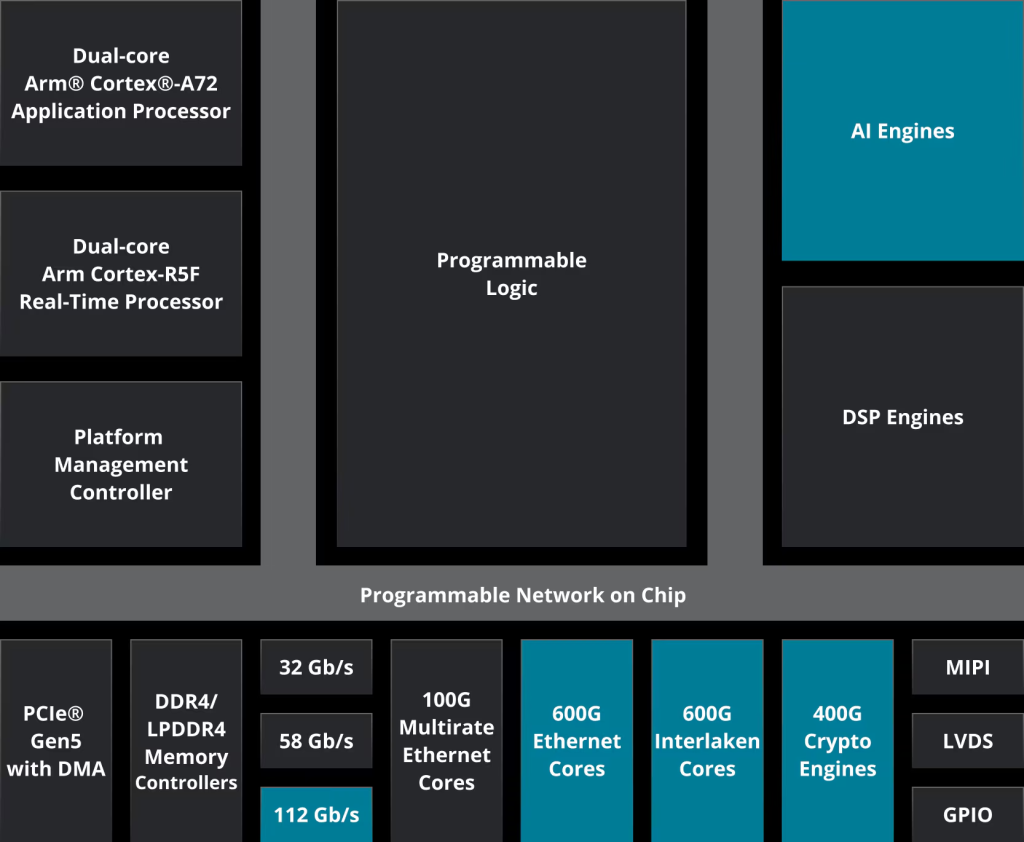
The result is true heterogeneous computing inside one device, delivering better performance, lower power, and lower latency. These are major reasons why AMD (Versal Gen 2) and Intel (Altera Agilex) are pushing toward engineering SoC-based FPGA designs, particularly for aerospace and defense systems that demand deterministic performance and long lifecycle support.
One important element which engineers should note is that SoCs aren’t necessarily smaller than previous-generation FPGAs. In fact, the overall package might be the same size — or even twice as large — yet deliver four times the capability. It’s a tradeoff many engineers will embrace: slightly larger silicon but dramatically improved performance and SWaP efficiency.
Replacing multiple chips with one SoC dramatically reduces total power consumption. Even when the SoC is the same size or slightly larger than a traditional FPGA, it’s far more computationally dense, allowing engineers to do more within a similar footprint and power allocation. This density is a key enabler of 3U VPX system optimization using SoCs in space- and power-constrained defense platforms.
Higher densities — with more hardened silicon blocks performing tasks inside the same package — also free up programmable fabric for custom mission logic. AI engines can handle sensor fusion and signal processing math directly in the hardware, while dedicated math units deliver higher throughput and lower latency than fabric-only designs, all while remaining configurable. This is a major advancement, as neural nets have required this level of efficiency for more than a decade, and silicon has finally caught up.
FPGA devices aren’t necessarily shrinking, but their capabilities are soaring. For example, AMD has been shipping 7-nanometer devices for a number of years, and 2-nanometer devices and smaller are on the horizon, promising even greater performance and power efficiency within the same envelope. These process advances directly support next generation FPGA capabilities for A&D systems that must handle AI, signal processing, and high-speed data movement concurrently.
Finally, SoCs offer significant cost advantages, as producing a single integrated device is typically more cost-effective than making multiple discrete components. It also simplifies integration and ensures compatibility, reducing design complexity. Ultimately, SoC architectures are ushering in a new era of next-generation FPGAs that are more capable than ever, yet less resource-intensive and more cost-effective to deploy. In aerospace and defense systems, where processing capability and power efficiency are critical to mission success, building platforms around SoCs provides a clear competitive advantage.
True SoC architectures are redefining what is practical in aerospace and defense FPGA systems. By enabling heterogeneous computing within a single device, SoCs deliver higher performance and efficiency without adding system complexity.
To discuss SoC-based FPGA architectures for your next A&D platform, contact New Wave Design.
If you need help finding the right interface, protocol or need to tweak our FPGA cards for your teams’ needs, contact New Wave Design to discuss your requirements.
Contact us today to see how New Wave Design can collaborate with you to achieve your objectives, leveraging our cutting-edge military and aerospace solutions. Experience our dedication to innovation, quality, and unparalleled customer satisfaction firsthand, and together, let’s turn your challenges into triumphs.
"*" indicates required fields