Back To Thought Leadership

Meeting Aerospace and Defense Challenges With Data Architectures
Published: 01/27/26
Published: 01/27/26
FPGA design choices are increasingly being shaped by system architecture decisions rather than individual component performance.
Emerging technologies will soon reshape FPGA engineering and deployment, particularly for aerospace and defense-grade applications where rapid data sharing, hardened security, and spaceborne reliability are mission-critical.
Here’s how these advancements are defining the next frontier of FPGA innovation.
In aerospace platforms, FPGAs are often responsible for managing how data moves and is processed across tightly constrained systems. As sensor counts grow and processing is distributed across CPUs, GPUs, and accelerators, the way memory is shared and accessed becomes a system-level concern rather than a board-level one. That shift is why emerging interconnect and memory-coherence technologies are starting to influence FPGA-based architectures.
In defense-grade applications, FPGAs are commonly used where security and reliability cannot be left to software alone. Encryption and authentication are pushed into hardware to maintain performance under threat conditions and degraded environments. Those requirements increasingly shape how security acceleration, quantum resistance, and radiation tolerance are designed into modern FPGA platforms.
We’ve discussed how RoCE v2 (Remote Direct Memory Access over Converged Ethernet) allows systems to share host memory between boxes. CXL has a similar goal, but instead of sharing box-to-box like RoCE v2, it shares memory inside the box over a PCIe network.
CXL offers multiple engineering advantages. A typical 3U VPX chassis might include several processing cards — CPUs, GPUs, and FPGAs — working together to achieve sensor fusion, where data from multiple sensors is shared and processed in real time. CXL provides a unified, coherent memory space that allows various devices — even from different manufacturers — to share data seamlessly, thus promoting modularity.
CXL could also reduce dependence on DDR memory, freeing valuable board space. Though DDR would still be required, it might be limited to a central DDR cache shared by all devices through CXL.
It might even influence system architecture. Let’s say you need more DDR bandwidth and depth, but you’re out of space. You might consider placing it on a mezzanine. Normally, that wouldn’t be possible due to pin count and signal integrity challenges. But, since CXL operates over PCIe, you could move DDR memory to the mezzanine without changing the board layout or backplane.
Though CXL isn’t yet readily available across most FPGA deployments, it’s a technology worth watching — engineers who understand its potential will be well-positioned to leverage CXL when it’s available for aerospace and defense-grade applications.
MACsec (Media Access Control Security) and IPsec (Internet Protocol Security) are critical requirements for modern cybersecurity. The key difference is that MACsec operates at layer 2, securing data within the local network, while IPsec operates at layer 3, securing data as it moves between networks. Both MACsec and IPsec require real-time encryption, decryption, and authentication at high data rates that can bottleneck software.
FPGAs can prevent bottlenecks by offloading those functions into hardware blocks or programmable logic. That’s why next-generation SoCs include dedicated blocks to accelerate MACsec and IPsec functions.
At the same time, quantum computing is emerging as a new opportunity (and a new threat) in cybersecurity. With quantum computing, sophisticated codes that were once thought unbreakable can be cracked in minutes, underscoring the need for quantum-resistant security in aerospace and defense applications.
Future FPGAs won’t just resist quantum attacks — they’ll proactively leverage quantum computing for security key generation, encryption, and tamper detection, verifying parts and software loads.
An entire ecosystem of security features is being developed for FPGAs, and because they are programmable, they’re being touted as quantum-ready. In other words, they can be updated with post quantum algorithms as they emerge, granting engineers future-proof flexibility.
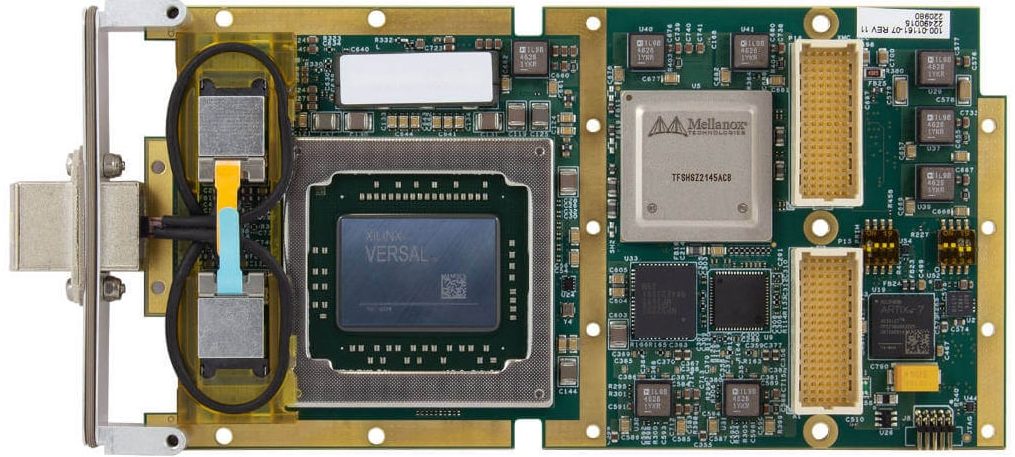
New Wave Design’s V6062 features AMD’s Versal Prime adaptive SoC featuring hardened IP and high-speed engines that enable IPsec encryption/decryption at 100G speeds. The V6062 also features NVIDIA’s ConnectX-7 NIC, which brings MAC Security (MACsec) encryption and decryption to the 3U VPX SOSA-aligned processing solution.
More and more FPGAs are being used in spaceborne applications, increasing demand for devices that can resist space’s extreme radiation. At the same time, growing concerns about warfare conducted over the RF spectrum are also driving demand for platforms that can resist radiation. Some even speculate that the next major peer-to-peer war will be fought in space and/or over the RF spectrum.
Over the next decade, companies that can supply rad-tolerant and rad-hardened FPGAs will have a distinct competitive advantage in the aerospace and defense sector — and engineers who know how to design reliable rad-tolerant and rad-hardened FPGA logic and boards will be in high demand.
FPGA technology continues to evolve at a rapid pace. It’s not just about what’s available today, but about preparing for what’s next. A&D engineers who stay ahead of that curve will position their programs, their organizations, and the missions they support for sustainable success.
Ready to discuss how these FPGA trends could influence a specific platform or program?
Contact New Wave Design to start the conversation.
If you need help finding the right interface, protocol or need to tweak our FPGA cards for your teams’ needs, contact New Wave Design to discuss your requirements.
Contact us today to see how New Wave Design can collaborate with you to achieve your objectives, leveraging our cutting-edge military and aerospace solutions. Experience our dedication to innovation, quality, and unparalleled customer satisfaction firsthand, and together, let’s turn your challenges into triumphs.
"*" indicates required fields