Back To Thought Leadership

How Rugged Optical Transceivers Enable Next-Generation Aerospace and Military Defense Systems
Published: 08/05/25
Published: 08/05/25
Modern aerospace and defense systems demand high-bandwidth, high-speed data movement to support mission-critical sensor fusion. But the optical transceivers used in traditional data centers aren’t built for the harsh, rugged environments of mil/aero fighter jets, UAVs, or ground combat vehicles.
Rugged optical transceivers bridge the gap by delivering high-performance optics in packages engineered to withstand extreme temperatures, shock, and vibration.
When the mission gets intense, traditional optics fail. See what today’s aerospace and defense systems are using instead.
Rugged optical transceivers provide reliable, accurate data transfer in extreme environments. They work by converting electrical signals into optical signals that are transmitted over fiber, then converting those optical signals back into electrical signals for processing.
This enables rugged optical transceivers to move massive volumes of data over long distances – for example, a 30-foot span from the nose cone of an aircraft to its electronics bay. Compared to copper, which typically maxes out at around 2 Gbps over long distances, fiber optics offer significantly higher data rates with far less signal degradation.
Rugged optical transceivers are also immune to crosstalk and other electrical interference, making them ideal for applications where hundreds of signals are simultaneously transmitted from multiple sensors.
The primary difference between standard data center optical transceivers and rugged optical transceivers is environmental resilience. Rugged modules are engineered to survive extreme conditions, making them ideal for aerospace and military applications.
A typical use case involves a multi-function aperture (MFA) and multi-function processor (MFP). In this scenario, a radar array receives pulse data and digitizes it. Then, the MFA transceiver converts that data from electrical to optical signals before transmitting it over fiber. On the other end, the MFP transceiver converts the optical signals back to electrical signals for processing in an FPGA or other digital signal processor.
Data center optical transceivers are typically rated for 0°C to 70°C, but modern aerospace and defense systems experience much greater temperature swings. Rugged optical transceivers reliably function from –40°C up to +85°C and beyond, making them suitable for avionics, satellite systems, and other outdoor, high-speed, and high-altitude deployments.
In addition, rugged optical transceivers offer superior shock and vibration resistance. Fighter jets, ground combat vehicles, and other systems experience intense mechanical stress, but rugged optical transceivers are designed to tolerate it.
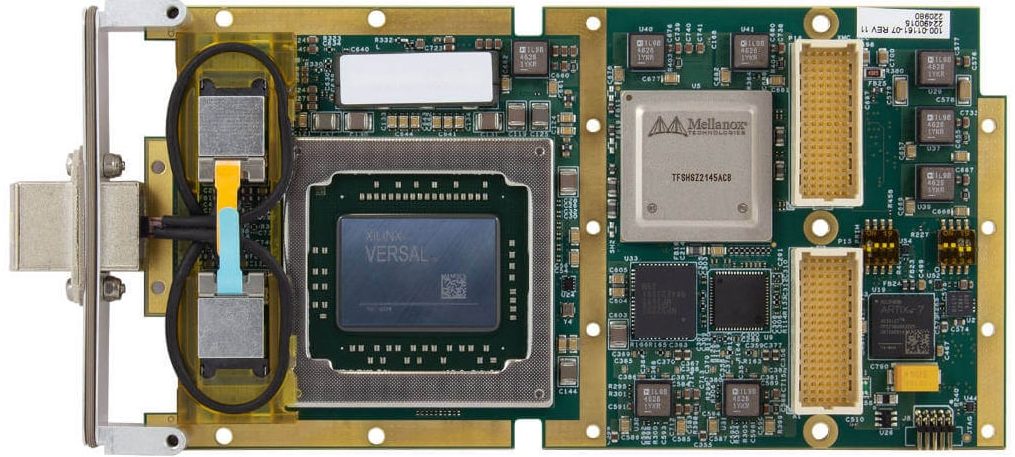
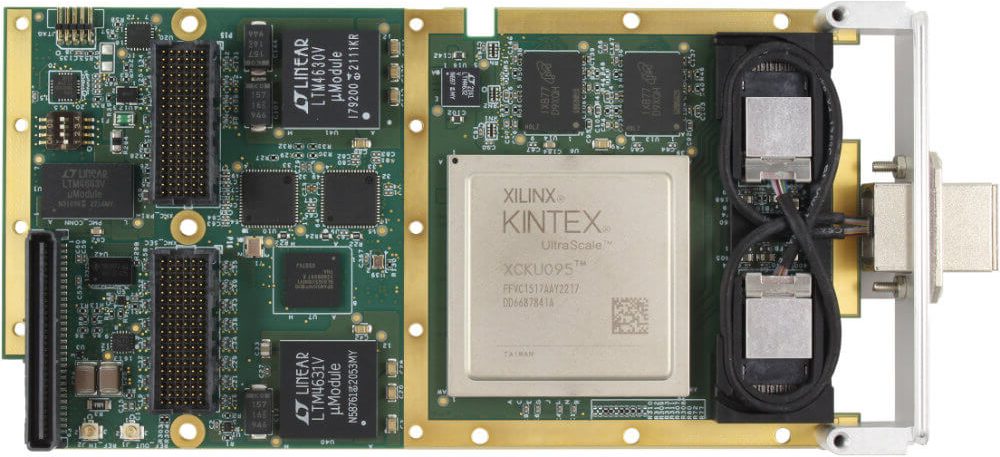
Rugged optical transceivers must be able to withstand all three extremes – temperature, shock, and vibration – to be reliable on the battlefield. For example, while traditional SFP/QSFP modules can be ruggedized for temperature, they often fail under shock and vibration because the mechanical lever that holds them in place can loosen, causing the module to pop out of the socket. Rugged optical transceivers employ mid-board optics directly soldered to the board or utilize rugged connectors to withstand shock and vibration.
Making the right choice isn’t just about performance — it’s about survivability. In aerospace and military defense environments, optical transceivers need to be able to stand up to extreme conditions without compromising speed or reliability. Here’s what to consider when making your selection:
Each of these factors can affect system integration, performance, and long-term reliability.
Rugged optical transceivers aren’t simply an optimization; they’re a crucial component of modern aerospace and military systems that demand reliable, high-bandwidth, high-speed data transfer to power sensor fusion and support real-time, high-stakes decision-making on the battlefield. Reach out to New Wave Design to learn more.
If you need help finding the right interface, protocol or need to tweak our FPGA cards for your teams’ needs, contact New Wave Design to discuss your requirements.
Contact us today to see how New Wave Design can collaborate with you to achieve your objectives, leveraging our cutting-edge military and aerospace solutions. Experience our dedication to innovation, quality, and unparalleled customer satisfaction firsthand, and together, let’s turn your challenges into triumphs.
"*" indicates required fields